What do Our Interns do?
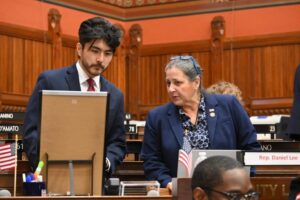
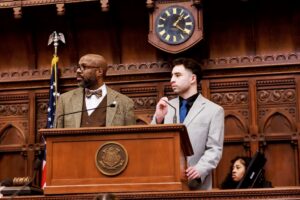
Interns are assigned to work with a legislator and/or legislative aide in the House Democratic Offices, Senate Democratic Offices, House Republican Offices, or Senate Republican Offices of the Connecticut General Assembly. Duties will vary from intern to intern, but the most common are:
- Track proposed bills through the legislative process
- Research the history and context of legislative issues or questions
- Research constituent questions and requests
- Outreach to other state agencies
- Draft testimony with the possibility of presenting in front of a committee
- Communication with constituents, CGA staff, and other legislators
- Track meeting minutes
- Assist in Joint Favorable Report writing
- Attend Legislative Session
- Attend public hearings and committee hearings
- Attend press conferences
- Other duties as assigned
Who is Eligible?
All undergraduates enrolled in a two- or four-year program at a Connecticut based and accredited institution can apply. Graduate students are not eligible for the program but can volunteer within the CGA or apply as a “non-program” intern.
Additional Student Requirements:
- Must be 18 years old at the start of the program
- Have 20+ undergraduate credits completed at the start of the program [Students may use up to 3 credit of high school Advanced Placement (AP)]
- Maintain 2.7+ GPA
- Register for credit with their institution (specifics will vary by institution)
- Campus liaisons can be found here
*Connecticut residents attending university out of state may apply to the program but must contact the director (angie.waszkiewicz@cga.ct.gov) to apply.
Schedule
The Legislative Internship Program runs from January through May, aligning with the spring semester and the Connecticut General Assembly’s legislative session. Students applying should be ready to participate for the full duration of the program.
The program begins with a required two‑day Orientation. To begin your placement, you must attend both full days. For the 2027 session, Orientation will be held January 21 and 22 from 8:00 a.m. to 5:00 p.m. at the Legislative Office Building, 300 Capitol Avenue, Hartford.
Interns typically work an eight‑hour day, most often from 9:00 a.m. to 5:00 p.m., though your exact schedule will be set in collaboration with your legislative aide. A 30‑minute on‑site lunch break is included. Interns work either Monday and Wednesday or Tuesday and Thursday, totaling 16 hours per week for 14 weeks. To complete the program, interns must earn at least 216 verified field hours.
Summary:
- Program runs January through May during the legislative session.
- Full participation for the entire program is required.
- Mandatory two-day Orientation on January 21-22, 2027, from 8:00 a.m. to 5:00 p.m. in Hartford.
- Typical workday is 9:00 a.m.-5:00 p.m., including a 30‑minute lunch break.
- Interns work 16 hours per week on either Mon/Wed or Tue/Thu.
- Minimum requirement: 216 verified field hours.
Academic Work
Interns are required to complete the following assignments in addition to any related course work their institution assigns.
- 1 Bill Tracking Research Project (10-12 pages and 1 poster)
- 1 Legislative Writing Project (varies)
- 1 Interview Summary with a CGA staff member (3-5 pages)
- 1 Reflection Paper (varies)
More information about assignments will be provided to students throughout the session. These assignments are graded on completion and effort. Students will receive individual comments to help gain experience.
Supplemental Opportunities
Alongside your legislative work and academic requirements, you’ll also have the chance to jump into optional career workshops, forums, field trips, and other cool opportunities throughout the session. These extras are totally up to you-but they’re a great way to make the most of your time here.
Mock Session:
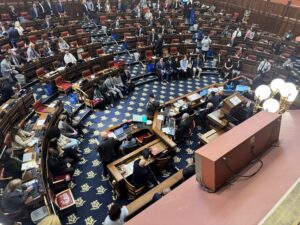
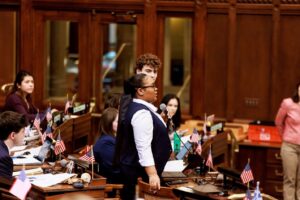
One of the highlights of the program is the mock legislative session in the House Chamber. During the second half of the internship, you and your fellow interns team up for about 4-6 weeks to pick bills, dig into research, and plan your caucus strategies. You’ll meet weekly, swap ideas, debate approaches, and get ready for the big day. It all comes together in an energetic half‑day mock session where you take on roles, make your arguments, and simulate the voting process. Some interns even take on extra responsibilities like managing the rules or running the tech during the vote.
Field Trips:
You may also get the chance to explore Connecticut beyond the Capitol. Interns often visit state agencies, local businesses, the State Supreme Court, the Old State House, and other organizations that help connect real world experiences to the issues you’re working on. The destinations change each year, but the goal is always the same—help you see how policy plays out in the world.
Program Administration
The Connecticut General Assembly Internship Program is administered by the statutorily created Committee on Legislative Staff Internships (CGS-2-84), along with the Internship Committee Director.
The Committee is a bi-partisan body with bi-partisan co-chairs, who alternate between the respective houses in each successive term. Their principal responsibility is the development and oversight of Connecticut General Assembly (CGA) internship program and policies. The Committee conducts all intern interviews and is responsible for intern assignment within the four caucuses. (See Selection and Placement below)
Since 1980, the Committee has retained the services of an administrator to serve as Director. The Director is responsible for the implementation of the Committee’s policies, administration and facilitation of the Legislative Internship Program (LIP), coordination and council of interns, as well as monitoring and reporting on intern performance and evaluation.
A Day in the Life of a CGA Intern
Every day at the Connecticut General Assembly brings something new, and that’s part of what makes the CGA Internship Program such an exciting experience. Here’s what a typical day might look like for one of our interns.
Starting the Day
Each morning begins by checking in with my Legislative Aide. Together, we review my assignments for the day-anything from answering constituent emails to preparing background research for an upcoming meeting on a current state legislative issue. Some days start with attending a public hearing or a committee meeting, where I take notes and get a firsthand look at the legislative process in action.
Lunchtime Connections
At lunch, I usually meet up with interns from other offices. It’s a great chance to compare experiences, share what we’re learning, and build connections with peers across the building.
Afternoon Training
After lunch, most days include an hour-long internship training session. These workshops cover a variety of topics and help us build the skills we need to succeed-both during the internship and in our future careers.
Project Work and Exploration
Following training, I head back to my office to finish projects or work on assignments I can manage independently. During this time, I might track bills, draft testimony for my academic internship project, or choose from opportunities happening around the building. Some afternoons I attend events that interest me, or I join one of the internship committees-like the Social Media Committee or the Mock Session Caucus-to get involved beyond my daily office work.
Wrapping Up
At the end of the day, I check in with my Legislative Aide, let them know I’m heading out, and then make my way to the parking garage to carpool back to campus-usually feeling like I learned something new and excited to be a part of this process.
Events and Field Trips